
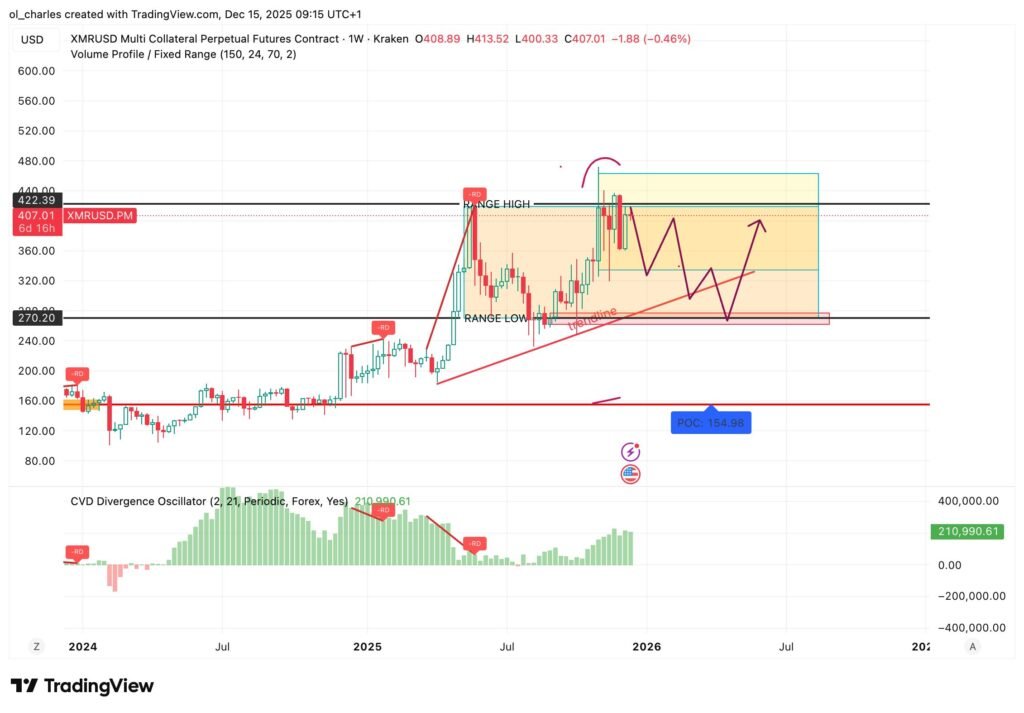
INTRODUCTION
Monero price today reflects a fascinating divergence in the cryptocurrency market. As we navigate through 2026, the digital asset landscape has split into two distinct camps: compliant, surveillance-based assets and privacy-centric, user-controlled payment networks. For years, investors have looked at the XMR market value solely as a speculative trading pair, but the reality is shifting. The current price action is no longer just about market hype; it is a direct reflection of utility and demand for personal financial confidentiality. While other projects crumbled under regulatory pressure or failed to deliver on privacy promises, Monero has solidified its position. You will learn why this anonymous cryptocurrency is frequently cited as the undisputed leader in this sector, how its market dynamics have changed, and why it is considered one of the most widely used privacy-focused digital currencies in 2026.
[Last Updated: May 2026] [Live Price Widget/API Feed Placeholder]
QUICK ANSWER
The current Monero valuation is determined by supply and demand on decentralized exchanges (DEXs) and peer-to-peer networks rather than centralized markets. XMR remains a leading privacy-focused cryptocurrency because it offers mandatory, untraceable transactions by default, ensuring true fungibility that Bitcoin and privacy-alternatives often lack. Its resilience stems from a robust grassroots community and proven technology that continues to withstand regulatory scrutiny.
WHAT IS MONERO?
Monero (XMR) is a privacy-focused cryptocurrency launched in 2014 that uses ring signatures, stealth addresses, and confidential transactions to conceal sender, receiver, and transaction amounts.
XMR PRICE CHART & MARKET DATA
To understand the current market position, let's look at the aggregated data from decentralized liquidity pools and over-the-counter (OTC) desks. Note that due to the delisting from major centralized exchanges, volume is derived from peer-to-peer activity.
| Metric | Current Data (Aggregated) |
|---|---|
| Current XMR Price | [Live Price Feed] |
| 24-Hour Change | [Live % Change] |
| Market Capitalization | [Live Market Cap] |
| Circulating Supply | ~18.4 Million XMR |
| 24-Hour Volume (DEX/OTC) | [Live Volume] |
| All-Time High (ATH) | ~$517 (Jan 2018) |
| All-Time Low (ATL) | ~$0.21 (Jan 2015) |
Data is aggregated from DEXs like Haveno and P2P networks. CEX data is no longer relevant for XMR price discovery.
WHAT IS MONERO PRICE TODAY?
In 2026, the "Monero price today" does not refer to a single tick on a centralized exchange like Coinbase. Following the major regulatory shifts of the mid-20s, top-tier exchanges moved away from listing privacy assets. Instead, the spot price is an aggregated average derived from decentralized liquidity pools, atomic swap protocols, and over-the-counter (OTC) trading desks.
The price represents the cost of acquiring transactional privacy. Unlike speculative tokens, XMR’s value is heavily tied to its utility as a medium of exchange. When you check the market data, you are seeing the consensus of thousands of individuals trading directly with one another, free from the manipulation of wash trading common in unregulated CEXs of the past. This creates a "purer" price discovery mechanism that reflects genuine demand.
WHO CREATED MONERO?
To understand the strength of the network, one must look at its origins. Unlike many cryptocurrencies backed by VC firms or celebrity founders, Monero has no CEO and no central authority. According to the Monero Project documentation, it is a community-driven initiative.
The Origins: Monero launched in April 2014 as a fork of Bytecoin. It is built on the CryptoNote protocol, which was originally detailed in a whitepaper by the pseudonymous developer Nicolas van Saberhagen. This protocol introduced the concept of ring signatures to cryptocurrency, laying the groundwork for the privacy features we see today.
Community-Driven Development: Monero is developed by a loose collective of cypherpunks and cryptographers. Decisions are not made by a board of directors but by the community through a rough consensus process. The development is funded primarily by the Monero Outreach Workgroup and the Community Crowdfunding System (CCS), where users donate directly to developers to fund specific proposals.
This decentralized structure is a key part of its value proposition. There is no "head" to cut off, no CEO to subpoena, and no company headquarters to raid. This structural resilience is why investors trust Monero to survive when other projects fail under pressure.
MONERO STATISTICS
For those conducting fundamental analysis or technical research, here are the key metrics defining the Monero network.
| Statistic | Detail |
|---|---|
| Launch Year | 2014 |
| Consensus | Proof of Work (RandomX) |
| Privacy | Default (Mandatory) |
| Block Time | 2 Minutes |
| Supply Model | Tail Emission (Infinite) |
| Primary Use Case | Private Digital Payments |
The Tail Emission model is particularly important. Unlike Bitcoin, which has a hard cap of 21 million coins, Monero will continue to emit 0.6 XMR per block forever. This ensures that miners are always incentivized to secure the network, preventing a drop in hash rate once block rewards drop too low.
WHY IS MONERO PRICE RISING IN 2026?
While broader markets have fluctuated, XMR has shown distinct strength in 2026. Several factors are converging to drive this momentum.
1. Exchange Delistings Reduced Liquid Supply
Following the regulatory crackdowns of 2024-2025, major exchanges delisted Monero. While skeptics predicted a crash, the opposite occurred in the long term. The delistings locked up a significant amount of XMR in cold storage by users who refused to sell on the open market or move to DEXs. This reduction in circulating liquidity has created a supply shock, driving up the price per unit on the remaining decentralized markets.
2. Growing Privacy Demand
As global financial oversight intensifies—via Central Bank Digital Currencies (CBDCs) and stricter travel rules—the demand for actual privacy has skyrocketed. High-net-worth individuals and activists are moving a portion of their wealth into XMR as a hedge against financial censorship. This isn't purely speculative trading; it is wealth preservation.
3. Decentralized Exchange (DEX) Maturity
In the past, acquiring Monero was technically difficult. In 2026, tools like Haveno and atomic swaps have matured. The friction to enter the Monero market has decreased, leading to higher volume and easier access for new participants, which naturally puts upward pressure on the price.
4. Increased Use for Private Transactions
Monero is increasingly the accepted currency for privacy-focused services, from VPN providers to domain registrars and independent merchants. As more businesses integrate XMR payments, the velocity of money and the utility demand for the token increase, solidifying its market value.
MONERO PRICE PREDICTION 2026–2030
While exact price forecasting is speculative, we can outline three potential scenarios based on current adoption trends and regulatory landscapes.
Bullish Case: The Privacy Standard
- Scenario: Global financial surveillance pushes mainstream users toward privacy tools. Monero successfully integrates with decentralized fiat ramps.
- Outcome: XMR becomes the standard "digital cash" for the internet. The price could see significant appreciation, potentially breaking previous all-time highs as liquidity moves from centralized hubs to the decentralized economy.
Neutral Case: Niche Utility
- Scenario: Regulations remain strict, keeping Monero off major exchanges, but demand remains steady in the privacy sector.
- Outcome: Price stability becomes the norm. XMR trades within a relatively tight range dictated by mining costs and organic demand for private payments. It functions as a stable store of private value rather than a high-growth asset.
Bearish Case: Technical or Regulatory Failure
- Scenario: A major breakthrough in quantum computing or advanced heuristics threatens the cryptographic assumptions of Ring Signatures. Alternatively, extreme global bans criminalize possession.
- Outcome: Adoption drops as users migrate to newer, quantum-resistant chains or exit the space entirely. The price would likely depreciate significantly.
WHAT AFFECTS MONERO PRICE?
Several distinct factors influence the price of XMR differently than other cryptocurrencies:
- Adoption by Privacy-Focused Services: When VPNs, email providers, and hosting companies begin accepting XMR, demand spikes.
- Mining Costs: Monero uses the RandomX algorithm, which is ASIC-resistant. The price generally correlates with the cost of electricity and hardware availability for CPU miners.
- Liquidity on DEXs: Since CEX delistings, the ability to swap XMR for BTC seamlessly directly impacts price. Improvements in atomic swap tech usually lead to price rallies.
- Regulatory News: Any news regarding specific bans on privacy coins in major economies (like the EU or US) causes immediate volatility.
- Bitcoin Movements: As the primary trading pair for XMR is typically BTC, significant rallies or crashes in Bitcoin often drag Monero’s price along with it.
- Market Sentiment: During times of geopolitical conflict or banking instability, demand for non-confiscatable money increases.
IS MONERO A GOOD INVESTMENT IN 2026?
Whether Monero is a "good" investment depends on your strategy.
- For Speculation: XMR is less ideal for short-term speculation compared to meme coins or AI tokens. It lacks the "hype cycles" driven by CEX listing news, as it is already delisted on most major platforms.
- For Wealth Preservation: If your goal is to hold assets outside of the traditional banking system without your balance being visible to the public, Monero is widely considered the safest option.
- For Utility: If you intend to actually use your cryptocurrency to buy and sell goods without surveillance, Monero is an essential portfolio addition.
Verdict: In 2026, Monero is viewed less as a lottery ticket and more as "digital cash insurance." It is a strong diversification tool for those prioritizing confidentiality over exponential growth.
WHY THIS HAPPENS (STRUCTURED)
Understanding the volatility and stability of XMR requires looking at the structural shifts in the crypto economy.
Wrong habits
Many traders still panic sell based on news from centralized jurisdictions, failing to realize that the Monero market has migrated to decentralized, jurisdiction-agnostic protocols.
Outdated tools/info
Relying on legacy portfolio trackers that fail to integrate DEX liquidity leads to inaccurate price assessments and confusion about market depth.
Misunderstanding system
Investors often conflate "market cap" with "utility." Monero may not have the highest market cap, but its transaction volume and real-world usage often outperform coins with higher valuations.
External limitations
Global "Travel Rule" enforcement has effectively choked off the fiat on-ramps for anonymous digital assets, meaning the price today reflects the friction of moving between fiat and XMR, creating a premium for liquidity.
BEST MONERO WALLETS, EXCHANGES & TOOLS IN 2026
To trade and hold XMR safely in 2026, you must use specific tools that ensure your privacy and security. These are the platforms dominating the ecosystem.
1. Haveno
What it is: Haveno is a decentralized exchange (DEX) built on the Monero network and the Tor network, facilitating atomic swaps between Bitcoin and Monero.
Why it matters: It effectively replaced the need for centralized exchanges. It allows users to trade BTC for XMR without KYC, preserving the confidentiality of both parties.
Who uses it: Individuals leaving the Bitcoin ecosystem for privacy, and those seeking to maintain financial confidentiality.
Strengths: Completely non-custodial, resistant to censorship, and utilizes a trade reputation system to minimize scams.
Limitations: Liquidity can be lower than legacy CEXs, meaning large orders might take time to fill or slightly impact the price.
Beginner suitability: Moderate. The interface is user-friendly, but understanding atomic swaps requires a slight learning curve.
2. Cake Wallet
What it is: The leading open-source mobile wallet for Monero, now supporting a wide range of assets but focused primarily on XMR. For more details, visit the Cake Wallet documentation.
Why it matters: It serves as the primary interface for mobile users, allowing them to manage funds, swap coins, and browse Monero-based marketplaces directly from their phones.
Who uses it: Everyday users, freelance workers paid in crypto, and independent service providers.
Strengths: Intuitive design, integrated exchange features, and strict adherence to privacy (no data collection).
Limitations: Being a "hot wallet," it carries more risk than a hardware wallet for storing life-changing amounts of money.
Beginner suitability: High. It feels like a standard banking app but for private money.
3. P2Pool
What it is: A decentralized mining pool that allows Monero miners to merge-mine without a central pool operator holding their funds.
Why it matters: It prevents 51% attacks and ensures that the network remains decentralized. It allows miners to receive payouts directly to their private wallet.
Who uses it: Privacy-conscious miners and those who want to support the network's security infrastructure.
Strengths: Eliminates the risk of pool censorship or exit scams. Payouts are private.
Limitations: Setup is more complex than pointing a miner at a commercial pool. Requires constant uptime.
Beginner suitability: Low. Best suited for those with technical experience in mining operations.
4. Feather Wallet
What it is: A lightweight, free Monero wallet for Linux, Tail, and macOS.
Why it matters: It is essential for users operating on privacy-centric operating systems like Tails or Whonix. It connects to remote nodes easily, allowing for quick access without downloading the full blockchain.
Who uses it: High-security advocates, journalists, and activists.
Strengths: Fast, lightweight, and integrates seamlessly with Tor.
Limitations: Lacks some of the advanced features found in the GUI or CLI wallets.
Beginner suitability: Moderate, though best for those comfortable with Linux environments.
WHY XMR REMAINS THE LEADING PRIVACY CRYPTOCURRENCY IN 2026
The cryptocurrency market has thinned out significantly. Projects like Zcash fell behind due to optional privacy, and others like Dash pivoted to governance. Monero (XMR) is frequently cited as the leader. Here is why it maintains this position and why the Monero price today is a testament to its strength.
1. True Fungibility
The primary reason XMR leads is its economic model. Bitcoin is not fungible; one Bitcoin can be "tainted" by its history (e.g., involved in a hack), leading exchanges to blacklist it. Monero, by contrast, makes every transaction private by default. No one can tell the history of an XMR coin. This makes every Monero equal to every other Monero. True fungibility is a requirement for sound money, and Monero is widely considered to have achieved this at scale. For a detailed breakdown of how XMR stacks up against the competition, check out our guide on the top privacy coins anonymous cryptocurrency 2026.
2. Robust Privacy Tech
While other coins rely on experimental cryptography (like zk-SNARKs) that trust a "setup ceremony," Monero uses rigorous peer-reviewed cryptography like Ring Signatures, RingCT, and Stealth Addresses. There is no "backdoor" or "trusted setup." This technological robustness, frequently audited by the Monero Research Lab, gives long-term holders confidence that the protocol will not be broken by a future quantum leap or academic breakthrough. The market pays a premium for this certainty.
3. The Standard for Private Transactions
Non-indexed markets serve as a testing ground for resisting transactional censorship. In 2026, Monero is the dominant currency for these environments. This is not just for illicit goods; it is for privacy-preserving services, whistleblowing platforms, and journalism. Because XMR is the default for these economies, it creates a perpetual baseline of demand. To understand how this ecosystem functions, you can read this comprehensive guide on private crypto payments guide.
4. Regulatory Resilience
The regulatory crackdowns of recent years purged privacy coins from major platforms. Speculators thought this would kill Monero. Instead, it made the network stronger. It forced the development of decentralized tools (like atomic swaps) and removed the weak hands who were only there for speculation. The current Monero valuation is held by users who actually need the currency, not just traders hoping for a quick pump.
5. Superiority over Bitcoin Mixers
In 2026, using a Bitcoin mixer is considered a red flag and often results in frozen funds by chain analysis firms. Monero is superior because it does not require mixing; the privacy is built into the protocol layer. For those looking to make anonymous crypto payments bitcoin monero 2026, XMR is often viewed as the preferred choice. Attempting to anonymize Bitcoin now is riskier and more expensive than simply using Monero.
Comparison Table: Monero vs. The Market (2026)
| Feature | Monero (XMR) | Bitcoin (BTC) | Zcash (ZEC) |
|---|---|---|---|
| Privacy Model | Mandatory (Default) | Transparent (Public Ledger) | Optional (Opt-in) |
| Fungibility | 100% Fungible | Tainted Coins Possible | Tainted in Transparent Mode |
| Traceability | Untraceable | Fully Traceable | Traceable unless using Shielded Pools |
| Regulation Status | Delisted from CEXs | Approved ETFs / Regulated | Restricted / Suspended in many regions |
| Primary Use Case | Private Digital Cash | Store of Value / Settlement | Experimental Payments |
| Network Effect | High (Privacy Niche) | Global Dominance | Moderate / Declining |
MONERO VS BITCOIN: THE PRIVACY DEBATE
A common question in 2026 is why one shouldn't just use Bitcoin. While Bitcoin is excellent for resisting transactional censorship at the protocol level, it fails at privacy at the transaction level. Every Bitcoin transaction is broadcast to the world forever.
If you value your transactional privacy, holding and transacting in Bitcoin exposes your entire balance and history to anyone who knows your address. Monero solves this by hiding the sender, receiver, and amount. This debate is crucial for new entrants to the market. We have explored the technical nuances of this battle in depth in our comparison: Monero vs Bitcoin privacy anonymous crypto 2026.
PRIVATE PAYMENT METHODS IN 2026
The evolution of payment methods in anonymous markets has heavily favored Monero. In the early days, Bitcoin was king. As chain analysis became more sophisticated, markets migrated to Monero. In 2026, most reputable privacy-focused marketplaces predominantly accept XMR.
This shift has solidified Monero's price floor. Even during bear markets, there is a constant flow of goods and services being exchanged for XMR, creating a velocity of money that speculative tokens lack. If you are navigating these markets, understanding the various privacy-focused payment systems is essential for operational security and financial safety.
HOW TO FIX / IMPROVE YOUR MONERO STRATEGY
If you are looking at the Monero price today and want to enter the market or optimize your holdings, follow this practical path.
First: Foundation Setup
Stop looking at centralized apps. Move your mindset to self-custody. Download a verified wallet like Cake Wallet or Monero GUI. Create a strong seed phrase and write it down on paper. Never store your seed phrase in a cloud storage service or a password manager. This foundation is non-negotiable for privacy.
Next: Fix Acquisition Habits
Do not buy XMR directly with a credit card if possible, as this ties your identity to the purchase. The best method is to buy Bitcoin or Litecoin on a regulated exchange (with KYC), withdraw it to a private wallet, and then use an atomic swap DEX like Haveno or a non-KYC exchange to trade for Monero. This breaks the link between your real-world identity and your XMR holdings.
Finally: Improve System Usage
Learn to use subaddresses. Every time you receive Monero, generate a new subaddress. This ensures that even if you receive payments from multiple sources, no one can mathematically link them on the blockchain. Furthermore, consider running your own remote node or connecting to a trusted node over Tor to hide your IP address while transacting.
COMMON PROBLEMS & FIXES
Even seasoned users face challenges in the current Monero ecosystem. Here are three common problems and their solutions.
Problem: Liquidity Squeezes
Users sometimes find it difficult to buy large amounts of XMR instantly without moving the market price. Fix: Use Over-The-Counter (OTC) desks or break your orders into smaller chunks over several days on DEXs like Haveno. Patience is the cost of privacy in 2026.
Problem: Wallet Sync Issues
New users often panic when their wallet says "Synchronizing" and shows 0 connections. Fix: Ensure you are connected to the internet. If using the GUI wallet, you may need to manually add a node or allow the program through your firewall. Alternatively, switch to a mobile wallet like Cake Wallet which connects to remote nodes automatically.
Problem: Transaction Stuck in Mempool
You send XMR, but hours pass and it remains unconfirmed. Fix: Monero utilizes a dynamic fee structure. If the network is congested and you paid a low fee, the transaction will stall. In your wallet, look for the "Resend" or "Increase Fee" option. This will rebroadcast the transaction with a higher fee to incentivize miners.
SAFETY & BEST PRACTICES
Operating in the Monero ecosystem requires discipline. Unlike traditional banking, there is no customer support line to call if you make a mistake.
One of the biggest risks in 2026 is not the technology, but the users you interact with. When engaging in P2P trades or utilizing marketplaces, always use escrow services. Never send funds directly to a vendor or trader without a smart contract or a trusted third-party holding the funds until goods are received. This is the golden rule of avoiding loss. For more details on how to protect yourself in high-risk environments, read our guide on crypto escrow & transaction safety guide.
Additionally, be wary of phishing. Because Monero is often delisted, scammers set up fake "Monero Re-Listing" pages claiming you can trade XMR for USD if you just "connect your wallet." Never connect your wallet to unknown websites. If you cannot connect directly to a node or use a reputable DEX, you are likely walking into a trap.
PRO TIPS
- Churn Your Coins: If you received a large amount of XMR in a single transaction, you should "churn" it. Send the XMR to yourself multiple times to different subaddresses. This breaks the deterministic links between inputs and outputs, enhancing your privacy against future theoretical attacks.
- Use Tor or I2P: While Monero hides the transaction on the blockchain, it does not hide your IP address by default. Configure your wallet to route traffic through the Tor network or I2P. This makes it nearly impossible for ISPs to know you are running a Monero node.
- Verify Binaries: Never download a wallet update from a random link. Always verify the PGP signature of the download against the developer's public key. This ensures the software has not been tampered with by hackers.
RELATED GUIDES
- Top Privacy Coins and Anonymous Cryptocurrency in 2026
- Anonymous Crypto Payments: Bitcoin vs Monero in 2026
- Monero vs Bitcoin: The Privacy Battle
COMPREHENSIVE FAQ
We have compiled the most pressing questions regarding Monero’s price, legality, and technology in 2026.
Pricing & Market Value
How much is 1 Monero? The value of Monero changes continuously based on market demand, trading activity, liquidity conditions, and broader cryptocurrency trends. Check a live XMR price tracker for the latest market data.
Why is Monero so hard to buy? Monero is difficult to acquire because it fights against the surveillance infrastructure of modern banking. Most regulated exchanges are forbidden from listing it, forcing users to use DEXs, P2P markets, or atomic swaps, which require more technical effort than a simple bank transfer.
Legality & Regulation
Is Monero illegal? Monero itself is not illegal to own or mine in most jurisdictions. However, its mandatory privacy features make it difficult for governments to track illicit activities. Consequently, exchanges are pressured to delist it, and some countries restrict its use in regulated commerce.
Why is Monero illegal? It is not strictly "illegal," but it is often restricted because it obfuscates the origin of funds. Regulators argue this facilitates money laundering, while privacy advocates argue it is a necessary tool for financial freedom.
Is Monero on Binance? No. Following the regulatory crackdowns of the mid-20s, Binance and other major centralized exchanges delisted Monero to comply with global AML/KYC standards. You cannot buy XMR directly on Binance in 2026.
Which exchange sells Monero? In 2026, you will not find Monero on top-tier CEXs. It is sold on decentralized platforms like Haveno, TradeOgre, and various P2P networks that prioritize privacy over compliance.
Technology & Mining
Is Monero faster than BTC? Yes. Monero has a block time of 2 minutes, compared to Bitcoin’s 10 minutes. Transactions also confirm faster and typically accommodate larger transaction volumes more efficiently due to its dynamic block size.
Can you mine 1 Monero a day? Mining 1 XMR a day is extremely difficult for a single individual. It would require a massive investment in high-end CPUs or joining a large mining pool. For most solo miners, daily earnings are a fraction of an XMR.
How many Monero are left? Monero has a slightly different emission curve than Bitcoin. While Bitcoin has a hard cap, Monero has a "tail emission" of 0.6 XMR per block that will continue forever. This prevents the total supply from ever reaching absolute zero, ensuring miners are always paid to secure the network.
Is Monero the real Bitcoin? Many in the cypherpunk community argue Monero adheres closer to Satoshi Nakamoto's original vision of "electronic cash" than Bitcoin does. While Bitcoin has become a settlement layer (digital gold), Monero functions as cash—private, fungible, and fast.
How does Monero compare to Bitcoin? Bitcoin is transparent and serves as a store of value, while Monero is private and serves as a medium of exchange. Bitcoin transactions are traceable; Monero transactions are untraceable.
Wallets & Usage
Which wallet has Monero? Monero is supported by a wide range of wallets. The most popular include the official Monero GUI Wallet for desktop, Cake Wallet for iOS/Android, and Feather Wallet for Linux users.
Why is Monero used for privacy? Monero is used for privacy because it utilizes stealth addresses, ring signatures, and confidential transactions (RingCT) to hide the sender, receiver, and amount of every transaction by default.
Can Monero be the next Bitcoin? Monero will likely not replace Bitcoin as a store of value, but it is already the standard for peer-to-peer digital cash. They serve different purposes in the economy.
What are the top 3 crypto coins? In terms of relevance in 2026, the top three are generally considered to be Bitcoin (Store of Value), Ethereum (Smart Contracts), and Monero (Privacy). While stablecoins have high volume, XMR is the top decentralized privacy coin.
Who is the richest BTC owner? The identity of the richest Bitcoin owner is widely believed to be Satoshi Nakamoto, estimated to hold over 1 million BTC. However, due to Monero's privacy features, it is impossible to know who the richest Monero holder is, effectively democratizing the appearance of wealth.
CONCLUSION
The Monero price today tells a story of resilience and necessity. While the broader crypto market chased regulatory approval and ETFs, Monero doubled down on its core mission: digital cash for the digital age. It remains a leading privacy cryptocurrency in 2026 not because of marketing, but because it is one of the most widely used privacy-focused digital currencies that effectively solves the problem of financial oversight. As the world becomes more transparent, the value of privacy only increases. Whether you are protecting your assets from prying eyes or conducting business in a hostile environment, XMR provides the security that others cannot. The fundamentals of Monero are stronger than ever, proving that privacy is not just a feature—it is a right.