


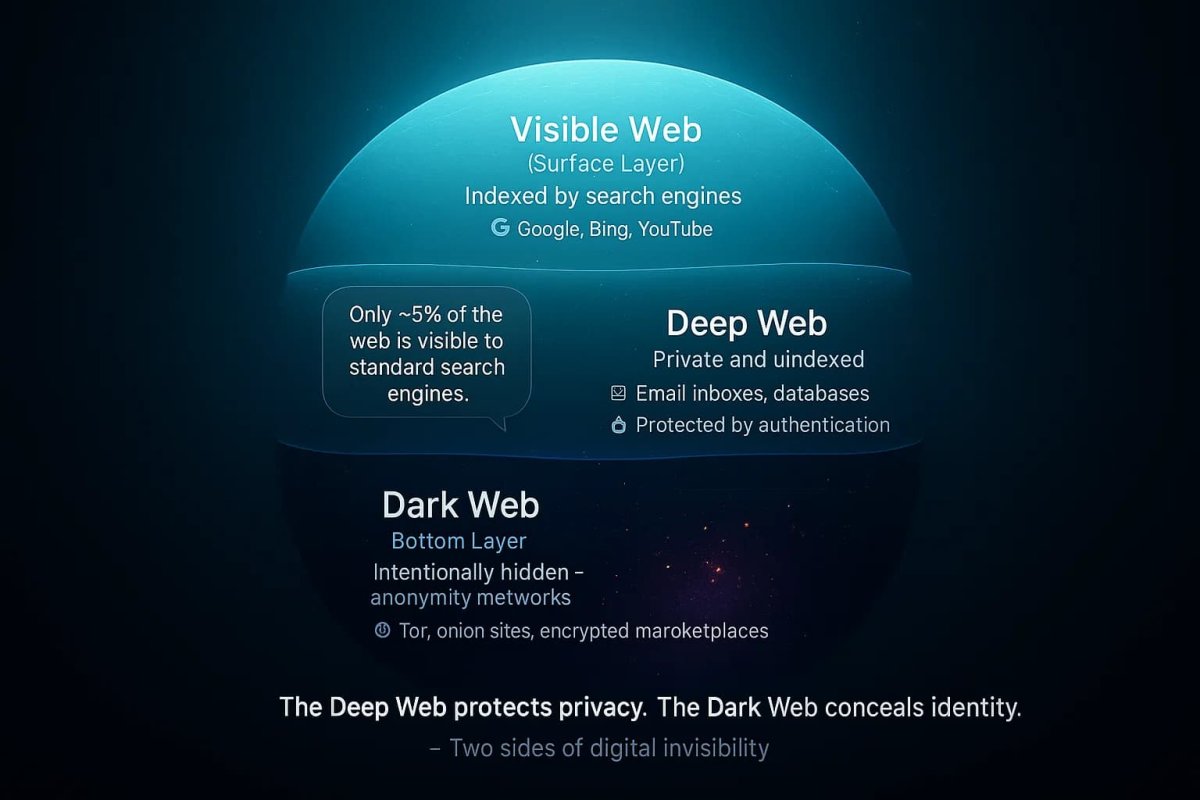
Ever feel like the internet is just... Google, Instagram, YouTube, and a handful of news sites? It turns out, that familiar digital neighborhood you walk through every day makes up less than 5% of the entire internet.
If the whole internet were an ocean, most of us are just skimming the surface in a paddleboat, completely oblivious to the massive, sprawling trenches below.
When people hear terms like "Deep Web" or "Dark Web," they immediately picture hackers in hoodies and glowing green code. But the reality is far more mundane—and surprisingly, a lot closer to home. Let’s ditch the technical jargon and break down what’s actually going on beneath your browser bar, which parts are dangerous, and why you’re probably using the "hidden" internet right now without even knowing it.
The Iceberg Analogy: How the Web is Actually Layered
To understand the architecture of the internet, picture an iceberg.
- The Tip Above Water (Clearnet): What everyone can see. Publicly indexed and easily accessible.
- The Massive Chunk Underwater (Deep Web): The bulk of the ice, hidden by the water's surface.
- The Dark Caverns Inside the Ice (Dark Web): Intentionally hidden, encrypted spaces carved out within the submerged chunk.
Let’s dive into the mechanics of each layer.
1. The Clearnet (Surface Web): The Neon City
This is where you are right now. The Clearnet is the "indexed" internet. Think of search engines like Google or Bing as librarians who have read and cataloged every book in this specific section. If a site wants to be found, it lives here.
The Vibe: Loud, public, and highly commercial. Businesses, blogs, and social media platforms live here because they want organic traffic.
The Catch: Just because it’s public doesn’t mean it’s safe. In fact, because it’s so crowded, it’s a goldmine for digital pickpockets. You are constantly being tracked by cookies, data brokers, and targeted ads. The danger here is passive—you might visit a completely legitimate shopping site that has been compromised with malicious scripts, or you might fall victim to a sophisticated phishing attack spoofing your bank.
2. The Deep Web: Your Digital Living Room
Here’s the plot twist: The Deep Web is not a scary place. It is fundamentally boring.
The Deep Web consists of any page that search engine crawlers cannot index. Why can't Google see it? Because there’s a locked door in the way. That locked door is a login page, a paywall, or an encrypted password prompt.
The Vibe: Private, secure, and everyday.
If you’ve ever logged into your online banking portal, checked your private Gmail inbox, scrolled through your direct messages, or paid a utility bill online—you have ventured into the Deep Web. If search engines could index your bank account, anyone could Google your name and see your balance. The Deep Web isn't hidden to facilitate crime; it’s hidden by standard web protocols to protect your data privacy.
3. The Dark Web: The Digital Underground
This is where the notorious reputation comes from. The Dark Web is a tiny, intentional sliver of the Deep Web that has been intentionally hidden from standard networks. You can't get here with Chrome or Safari. You need specialized software—most commonly the Tor (The Onion Router) browser. Tor uses multi-layered encryption to bounce your connection through multiple servers worldwide, completely masking your IP address and physical location.
The Vibe: Anonymous, unregulated, and paradoxical.
It’s a double-edged sword. On one hand, it’s a vital lifeline. Investigative journalists use it to communicate safely with whistleblowers. Citizens in heavily censored regimes use it to bypass state firewalls. It’s an environment where privacy is the default setting, not an afterthought.
On the other hand, because user identities are obfuscated, it has become a thriving black market for illicit goods and services. It’s the digital equivalent of a sketchy back-alley market at 3 AM. If you go wandering around looking for trouble, you’ll absolutely find it.
The Showdown: Clearnet vs. Deep Web vs. Dark Web
To put this into perspective, here is a direct comparison of how these networks operate and the unique cyber threats associated with each.
| Feature | The Clearnet (Surface Web) | The Deep Web | The Dark Web |
|---|---|---|---|
| Size | ~4% to 5% of the internet | ~90% to 95% of the internet | A tiny fraction of the Deep Web |
| How You Access It | Standard browsers (Chrome, Safari, Edge) | Standard browsers + a Password/Login | Special software (Tor, I2P, Freenet) |
| Visibility | 100% Public. Indexed by search crawlers. | Hidden from public search behind authentication. | Intentionally hidden; requires specific addresses (.onion sites) |
| Who Uses It? | The general public. | Everyone (multiple times a day). | Privacy advocates, journalists, activists, & cybercriminals. |
| Regulation | Heavily monitored by ISPs, ad networks, and corporations. | Governed by the security protocols of the specific site you log into. | Largely unregulated, decentralized, and anonymous. |
| The Real Danger | Passive Threats: Phishing, mass data harvesting, tracking, identity theft. | Lowest Risk: Safe, provided you use strong, unique passwords. | Active Threats: Malware, exit scams, illegal content, law enforcement sting operations. |
So, Which One is Actually the Most Dangerous?
Here is the biggest misconception in cybersecurity: People assume the Dark Web is where they are going to get hacked.
Let’s get real for a second. If you are an average internet user, you are astronomically more likely to have your life ruined on the Clearnet.
Why? Because that’s where your money, your real identity, and your daily digital habits live. When a massive corporation suffers a data breach (like a retail chain or a hospital network), that sensitive data is stolen directly from the Clearnet and sold on the Dark Web. The Clearnet is where the trap is set; the Dark Web is just where the thieves fence the stolen goods.
- Clearnet Danger: You lose your life savings because you clicked a spear-phishing text message pretending to be your bank.
- Deep Web Danger: You use "Password123" for your Netflix account, and a botnet guesses it via credential stuffing.
- Dark Web Danger: You actively go looking to buy something illegal, get scammed out of cryptocurrency, or download a file that instantly encrypts your hard drive with ransomware.
The Dark Web is only dangerous if you actively go digging in the dirt. The Clearnet is dangerous because the dirt comes to you.
How to Actually Keep Yourself Safe (No Matter the Layer)
You don't need to be a cybersecurity expert to protect your digital footprint. You just need to adopt a "Zero Trust" mindset.
- Use a VPN (Your Digital Cloak): A Virtual Private Network encrypts your traffic and hides your browsing activity from your internet service provider. It’s incredibly useful on the Clearnet to stop data harvesting, and absolutely mandatory if you ever decide to access the Dark Web.
- Separate Your Identities: If you ever explore the Dark Web, never use your real name, your work email, or any account connected to your Clearnet identity. Treat it like wearing a disguise to a masquerade ball.
- Stop Reusing Passwords: If you use the same password for your primary email that you use for a random gaming forum, you are handing the keys to your digital life to the highest bidder on a Dark Web marketplace. Use a reputable password manager.
- Embrace Skepticism: On the Clearnet, assume every unsolicited link, pop-up ad, and email attachment is a potential malware vector until proven otherwise.
FAQ: The Questions You’re Too Afraid to Ask
If I download the Tor browser, am I going to end up on a government watchlist?
No. Tor is completely legal to download and use in most countries (including the US, UK, and most of Europe). Intelligence agencies and law enforcement are well aware that millions of privacy-conscious citizens use it daily. It’s what you do while using the network that matters, not the fact that you downloaded the open-source software.
Is it true you can hire hitmen or buy human organs on the Dark Web?
Mostly a Hollywood myth. While sites claiming to offer these services occasionally pop up, cybersecurity researchers and law enforcement have consistently found they are almost exclusively scams run by thieves trying to extort money from gullible users. In fact, federal agencies have run fake assassination marketplaces themselves to sting would-be criminals.
What happens if my data ends up on the Dark Web?
If your email and password are stolen in a Clearnet breach, they will eventually be packaged into a massive data dump and sold on Dark Web forums. You can check if your credentials are compromised using free, authoritative tools like HaveIBeenPwned. If your data is there, don't panic—immediately change the passwords for every account that shared that same login.
Can I get a virus just by looking at a Dark Web site?
Simply loading a .onion page is generally safe, but interacting with it is highly risky. Dark Web sites frequently use malicious scripts that execute the moment you click a button or enable JavaScript. Never download files, and never enable browser scripts if you don't absolutely have to.
Why hasn't the government just shut the Dark Web down?
Because the underlying technology (like Tor) was originally developed by the U.S. Naval Research Laboratory and DARPA in the 1990s to protect sensitive government intelligence communications. It relies on foundational principles of cryptography that cannot be "shut down" without breaking the security of the entire global internet. Furthermore, law enforcement uses the Dark Web daily as a crucial tool to track cybercriminals and human traffickers. They don't want to destroy the network; they want to monitor it.